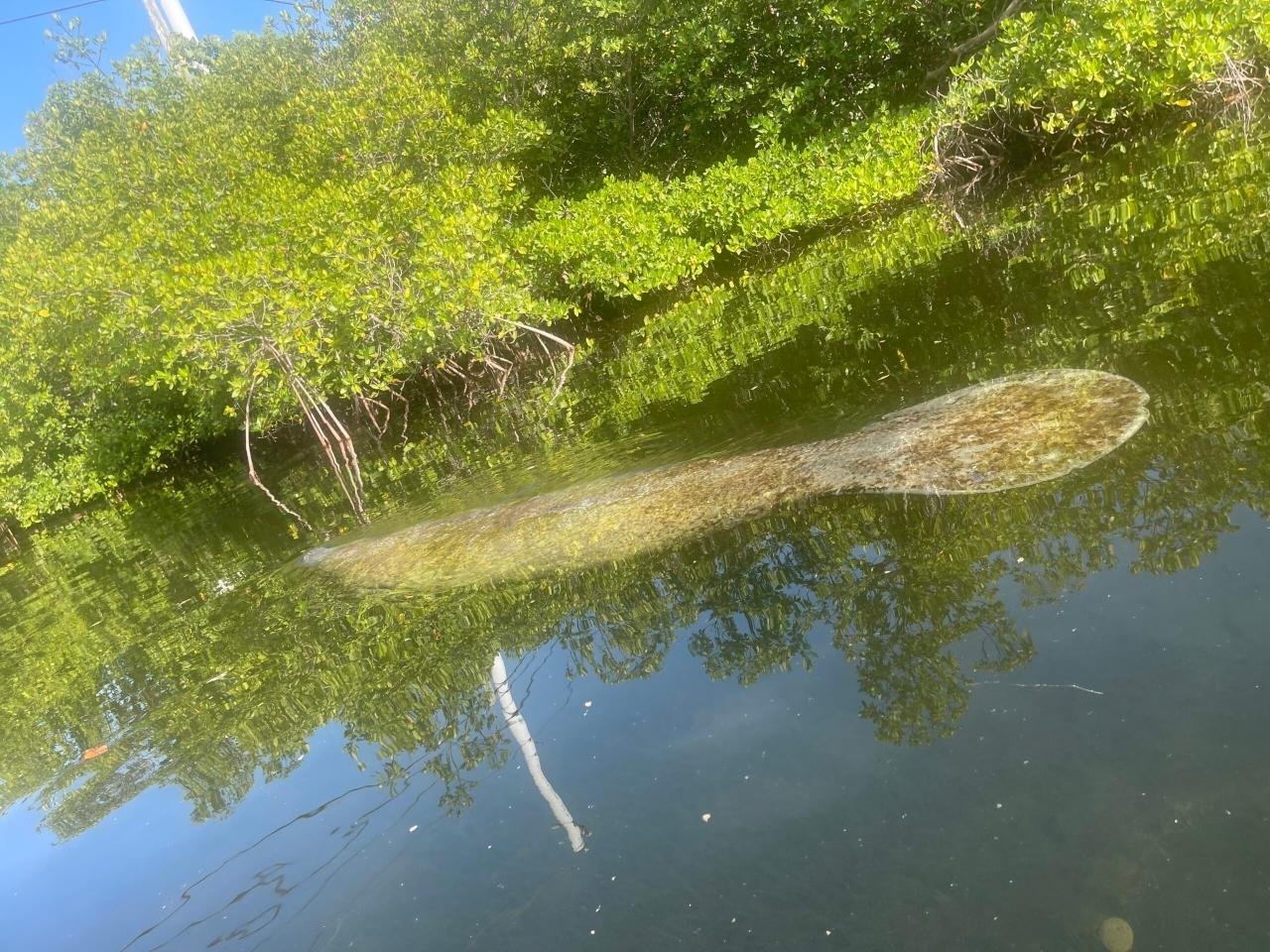
Manatees in the Florida Keys: Where and When to Look
Florida manatees are famous for crowding into the clear springs of the state's northwest in winter — and famous, wrongly, for nowhere else. They are around the Keys too, in the marinas, canals and mangrove creeks, from the basin of Cow Key Marina on Stock Island up to the creeks of Tavernier. Here is where they live, what any sighting depends on, and how to share their water without breaking the rules that protect them.
- Seen around the Keys in every season
- Protected by state and federal law
- Look, but don't touch
A manatee is an animal that rewards patience and punishes hurry — not because it is dangerous, but because it is wild, protected and entirely uninterested in your itinerary. Around the Keys, that patience pays off in more months than most visitors expect, and the way you behave when it does is genuinely regulated.
This guide is about the animals around Key West and the islands north of it. Crystal River's famous springs are a different destination entirely: the town sits on Florida's Gulf coast, roughly eight and a half hours of driving from Key West by one estimate, with the drive back still to come (TravelMath, with actual time varying by route, traffic and stops). Here in the Keys, the experience is watching well from quiet water, and a kayak is the quietest water there is.
Are there manatees around Key West?
Yes — regional references describe manatees around the Keys in every month of the year, and the tours here report encounters across the calendar. They are not concentrated the way they are at Florida's big warm-water springs, so an encounter is never a certainty, but they use exactly the waters visitors paddle: the marinas, the canals, the seagrass flats and the mangrove creeks. Even Cow Key Marina on Stock Island, the departure point for the local mangrove kayak tours, describes the manatees that visit its basin.
What the Keys offer, in other words, is not a guaranteed manatee show but a fair chance of a genuine one — wild animals, doing wild-animal things, in water quiet enough that neither party panics.
Do the seasons matter here?
What is well established is general Florida biology: manatees are warm-water animals, and when water stays below roughly 68 degrees Fahrenheit for extended periods they depend on warm refuges — springs, power-plant outflows, deep canals — and gather at them through cold spells. That is why the famous winter aggregations exist at places like Crystal River.
What that biology does not tell you is when a manatee will appear on any particular Key West or Tavernier paddle. We could not find documented evidence of a seasonal sighting peak on these routes, and we will not invent one. The tours compared on this site run year-round, regional references place manatees around the Keys in every season, and the reviews behind them record encounters from winter and summer alike. What an individual morning produces depends on the animals' movements, the weather and the water.
So plan around your trip rather than a calendar. Pick the departure that fits your dates, treat any field report — including ours — as one traveler's morning rather than a pattern, and let the sighting be what it is: possible, in any month, and never scheduled.
Where they surface
Manatees are not reef animals. Around the Keys they favor the quiet, shallow, human-adjacent water nobody photographs for brochures: marina basins and boat channels, canal mouths, seagrass flats at a food depth, and the warm, brackish creeks that wind through the mangroves. The dedicated manatee eco tour compared on this site runs on the Upper Keys side of that map — it launches from a shop on Tavernier Creek and watches for the animals from quiet kayaks.
Near Key West, keep an eye on the basin at Cow Key Marina on Stock Island and the flats and channels toward the island's southeast corner — the same waters the two- and three-hour mangrove tours paddle. The rule of thumb is unglamorous: manatees follow the seagrass and the quiet water.
The rules, in plain language
Manatees are protected by federal law — the Marine Mammal Protection Act and the Endangered Species Act — and by Florida's own manatee protections. The Florida Fish and Wildlife Conservation Commission compresses the whole thing into a phrase every paddler should memorize: look, but don't touch.
In practice that means: do not pursue or chase a manatee, in a kayak or a boat or swimming. Do not touch, hold, stand on, chase, corner, feed or give water to one — feeding and watering teach wild animals to seek people and boats, which ends badly for the animal. Observe by passive observation: stay at a distance, keep noise down, and let the manatee control the encounter. If one approaches your kayak, stay still and let it happen rather than reaching for it. None of this is etiquette — it is law, and it applies to everyone on the water, guided or independent.
Meeting them from a kayak
A kayak has real advantages for this kind of watching: no motor, no propeller, and a pace that can slow to a drift — which suits Florida's passive-observation guidance well. The guided options split neatly by intent. Near Key West, the two- and three-hour mangrove tours include manatees on their wildlife list along with nurse sharks, rays and turtles. In the Upper Keys, the dedicated eco tour from Tavernier makes manatees the organizing idea — small groups, single or double kayaks, a guide who watches the creek for what it shows.
The dedicated tour is a commitment — roughly a two-hour drive from Key West each way — so the choice is really about what your trip is for. A mangrove-forest morning with a manatee as the possible highlight, or a manatee morning with the forest as the setting. The comparison page lays out prices, departures and plain wildlife expectations side by side.
If you see one
Stop paddling or slow to a drift. Give the animal the water it wants, watch quietly, and take the memory instead of the selfie. If a manatee chooses to linger near your kayak, FWC's guidance is to stay still and let the animal be the one that closes the distance.
If you spot a manatee that is injured, orphaned or being harassed, report it to the FWC's wildlife alert line rather than intervening yourself — the numbers are on the FWC website linked below.
Ready to share their water?
The kayak tours built for manatees — one from the creeks of Tavernier, two from the mangroves near Key West — are compared here with prices, departure points and plain wildlife expectations.
See Manatee Kayak ToursWhere these facts come from
- Florida Fish and Wildlife Conservation Commission, manatee viewing guidelines — look but don't touch, do not pursue or chase, practice passive observation (myfwc.com).
- Florida Fish and Wildlife Conservation Commission, guidelines for paddlers around manatees (myfwc.com).
- U.S. Fish and Wildlife Service and Florida Fish and Wildlife Conservation Commission manatee information: manatees depend on warm-water refuges and cannot tolerate water below about 68 degrees Fahrenheit for extended periods (fws.gov, myfwc.com).
- TravelMath driving-time estimate, Key West to Crystal River, retrieved 1 October 2026 (travelmath.com). Actual travel time varies with route, traffic and stops.
- Cow Key Marina's own manatee information, describing the marina basin as a place manatees visit (cowkeymarinakeywest.com).
- Regional travel references describing manatees as present around the Florida Keys, including Visit Florida's where-to-see-manatees guide (visitflorida.com). These describe presence, not a local seasonal peak — none was found for these routes.
- GetYourGuide listings for the tours compared on this site, retrieved 29 September 2026, for tour-scoped wildlife language.
Viewing rules and protection status reflect the FWC guidance cited above. Seasonal patterns around the Keys reflect regional wildlife references and the operators' own tour language — sightings everywhere on this page are possibilities, never promises.