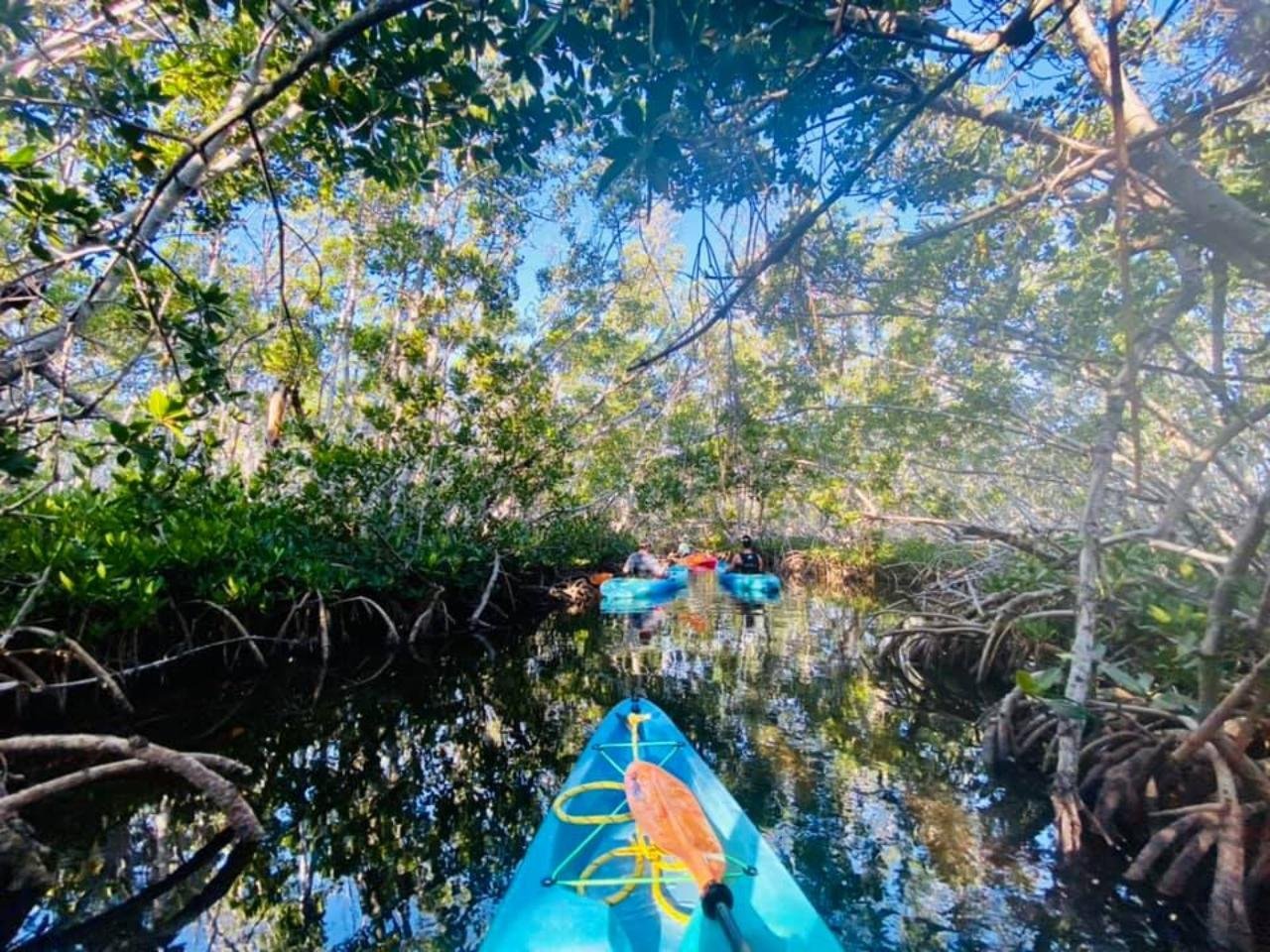
Key West Mangroves: The Island's Hidden Forest
A short hop from the bars of Duval Street, the Key West mangroves still stand in tunnels and creeks, doing the quiet work that keeps an island an island. Here is what the forest is, why it survived, who lives in it — and how to get inside it without harming it.
- Red, black and white mangroves
- Protected under Florida law
- Best entered by kayak
Key West sells itself as a two-mile-by-four-mile party at the end of the Overseas Highway, and most visitors experience exactly that. The island's other identity is quieter and much older. The Keys have a limestone foundation, and the mangrove forest on the island's southeast side is a knot of tunnels, creeks and shallow flats that the tour operators who work it still describe as relatively unspoiled by development — one of the last places on the island that looks the way the Keys looked before the condos.
This guide covers the forest as a place, not a product: what mangroves actually are, what this particular stretch is doing there, which animals use it, and what you should know before you paddle into it.
What mangroves actually are
Mangroves are trees that do what no ordinary tree tolerates: they grow in salt water. Florida has three species — red, black and white — and each handles the salt differently. Red mangroves are the dramatic ones, standing on prop roots above the waterline like a forest on stilts. Black mangroves push up pencil-thin roots through the mud around their bases to breathe, and white mangroves hold the line slightly farther inland. Together they colonize the shallow tropical shoreline, dropping leaves that feed the system and roots that trap everything else.
The result doesn't look like a forest from the water. It looks like a wall of green — until a channel opens in it, wide enough for a kayak, and the wall closes behind you.
The Key West stretch
The stretch that matters to a visitor is the one the tours paddle: the mangroves on the southeast side of Key West, as the operators themselves describe the forest they work. Inside are tunnels cut through by tidal flow, creeks that flush green and clear with the water's mood, and flats so shallow that the boat beneath you seems to float on glass. The operators' own descriptions of it — protected, relatively unspoiled, a window onto the Keys as they were — have the ring of sales talk until you are inside the canopy and the town disappears.
Up the highway, the same ecosystem repeats along nearly the whole island chain. The creeks of Tavernier, roughly ninety miles north, are where the manatee-first eco tour compared on this site runs its trips — the same kind of forest, watched for the same animals by a crew whose whole morning is organized around them.
Why mangroves matter
Florida's Legislature answered this one directly: mangrove resources are valuable to the state's environment and economy. Florida's mangrove protection law — the Mangrove Trimming and Preservation Act — regulates trimming and alteration, with exemptions and permitting pathways. How any one stand came to survive where it stands is a local story.
The protection is earned. The tangle of roots gives young fish and other marine life food and shelter from predators, which is what turns a mangrove stand into the nursery of the waters around it. The trees also stabilize the coastline itself, reducing the erosion that storm surge, waves and tides would otherwise carve from a low island. An island that keeps its mangroves keeps its shape.
Who lives in the tunnels
The cast changes daily, but the listings of the tours that work this water name the regulars: manatees grazing the flats, nurse sharks resting in the shallows, stingrays, sea turtles, jellyfish drifting with the tide, sea stars and sea cucumbers on the bottom, herons and pelicans above, and the occasional dolphin passing through the channels. None of them is scheduled, and no tour can promise any of them.
Manatees deserve one special note, because the rules around them are stricter than around anyone else on the list. They are protected by both federal and Florida law, and the standard is passive observation: watch from a distance, never touch, feed, pursue or chase, and let the animal decide how close the encounter becomes. A kayak — quiet, low, slow — is one of the least intrusive ways to share their water, which is exactly why the manatee-first tour is built around one.
Seeing it by kayak
You can look at mangroves from a road, but you can only really enter them by water, and a kayak is the tool the forest was waiting for. Guided tours solve the two genuine problems of the maze — navigation and knowledge — and hand you a third thing for free: pace. The tunnels are best taken slowly, both for the wildlife and because the narrower passages reward a steady paddle stroke over a fast one.
The guided mangrove tours leave from Cow Key Marina on Stock Island, just east of Key West, in two-hour and three-hour formats, the longer one listing an optional stop-and-swim. If your trip is built around manatees rather than the forest itself, the dedicated eco tour from Tavernier — about a two-hour drive up the Keys — makes the animals its organizing idea. Both options are compared side by side — prices, formats and what each includes.
Prefer to read before you paddle? The manatee guide on this site covers sightings around the Keys and the rules that govern meeting the animals.
Before you go
Three practical notes, then the water. Wear shoes that can get wet and clothes that dry fast. Bring water and sunscreen: the canopy is shady, but the flats between tunnels are full sun. For timings, check the booking calendar — departures run at set times rather than on demand.
Last, a rule that is both law and courtesy: take nothing but photographs, leave nothing but paddle strokes. Littering is prohibited on the tours, and the forest's protection only works if the visitors hold up their half of it.
The forest is better with a guide
The tunnels do not signpost themselves. The guided mangrove kayak eco tours compared here handle navigation, timing and the wildlife rules, so the only thing left for you to do is paddle and look.
See Mangrove Kayak ToursWhere these facts come from
- Florida Department of Environmental Protection and Florida Statutes 403.9321–403.9333 (the Mangrove Trimming and Preservation Act), which states the Legislature's intent to protect and preserve mangrove resources valuable to Florida's environment and economy (floridadep.gov).
- NOAA Ocean Service mangrove habitat background — shelter and food for young marine life, and coastline stabilization that reduces storm-surge and wave erosion (oceanservice.noaa.gov).
- Florida Keys National Marine Sanctuary habitat background — the Keys' limestone foundation and mangroves' role in the island ecosystem (floridakeys.noaa.gov).
- Florida DEP mangrove frequently asked questions, for the trimming and alteration rules and their exemptions (floridadep.gov).
- Florida's three mangrove species — red, black and white — as described in state and federal coastal-ecology references.
- GetYourGuide listings for the Key West and Tavernier operators compared on this site, including their descriptions of the protected forest on Key West's southeast side, retrieved 29 September 2026.
- Meeting points and durations for the tours named on this site were checked against their live listings on 30 September 2026, and the two Key West departures were re-checked on 1 October 2026.
Ecology and protection facts reflect the cited official sources on the date shown. Tour details and wildlife expectations reflect the operators' listings, which describe sightings as possibilities rather than guarantees.